
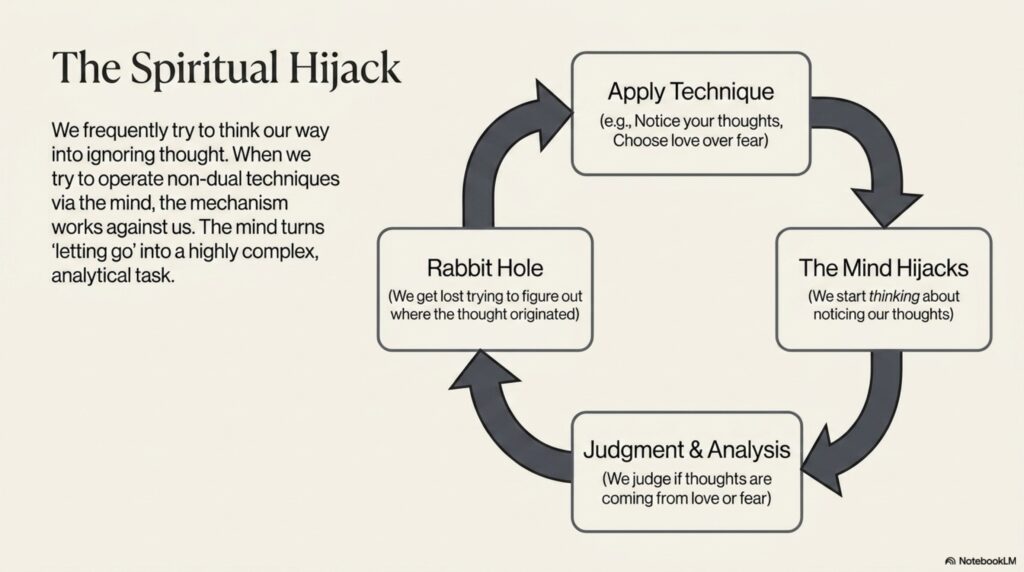
- Trying to fix thought with more thought just reapplies the mind’s “Swiss Army knife” to everything.
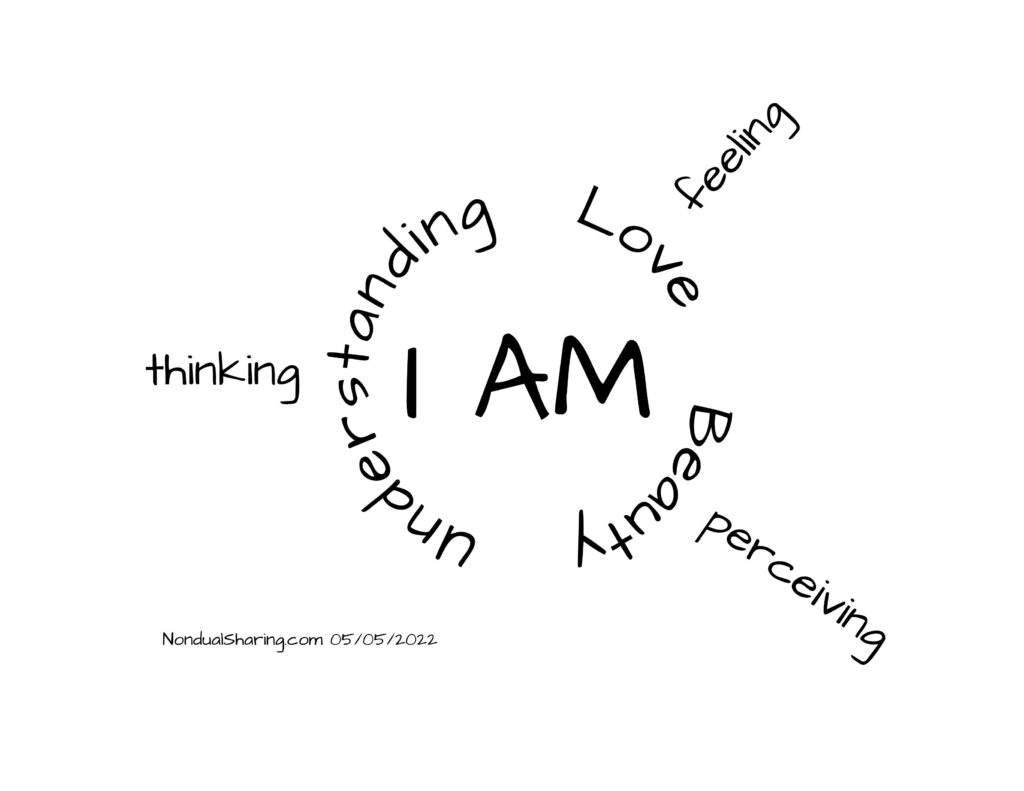
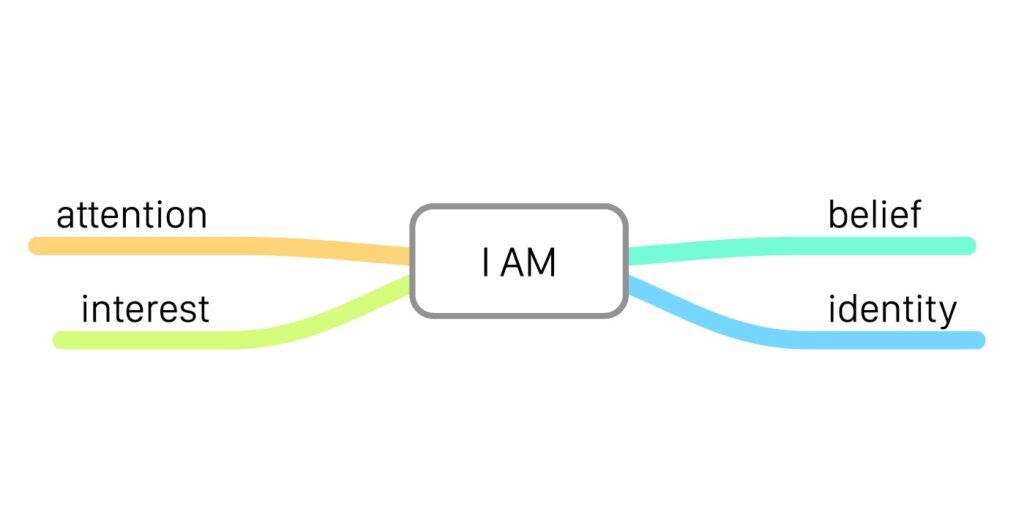
- The real shift: stop identifying with thought and instead recognize/rest as the awareness that knows it — simply “I am” or “I am here.”
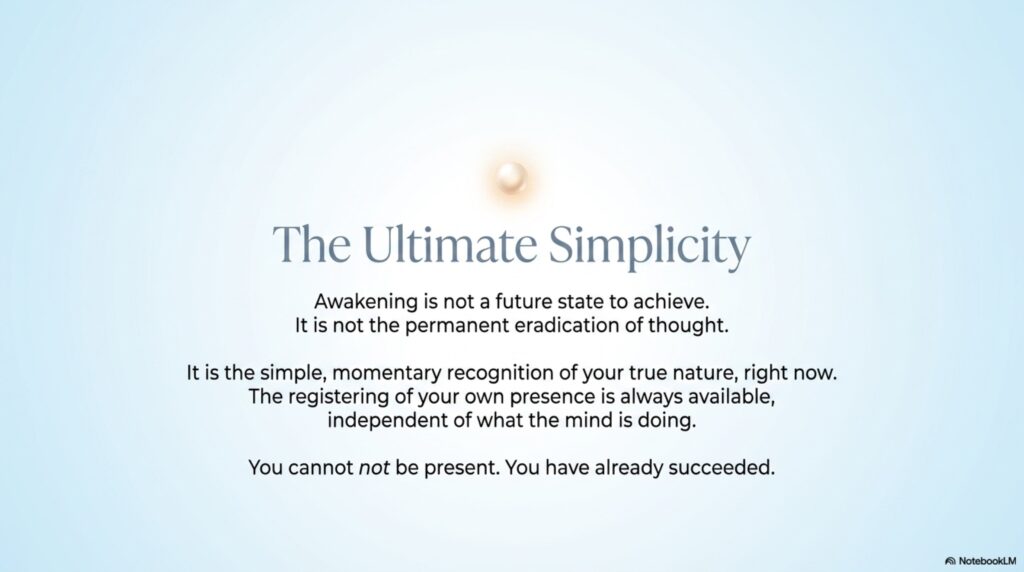
- This is not a technique but an immediate, effortless recognition.
- “I am” remains constant and accessible without needing management.
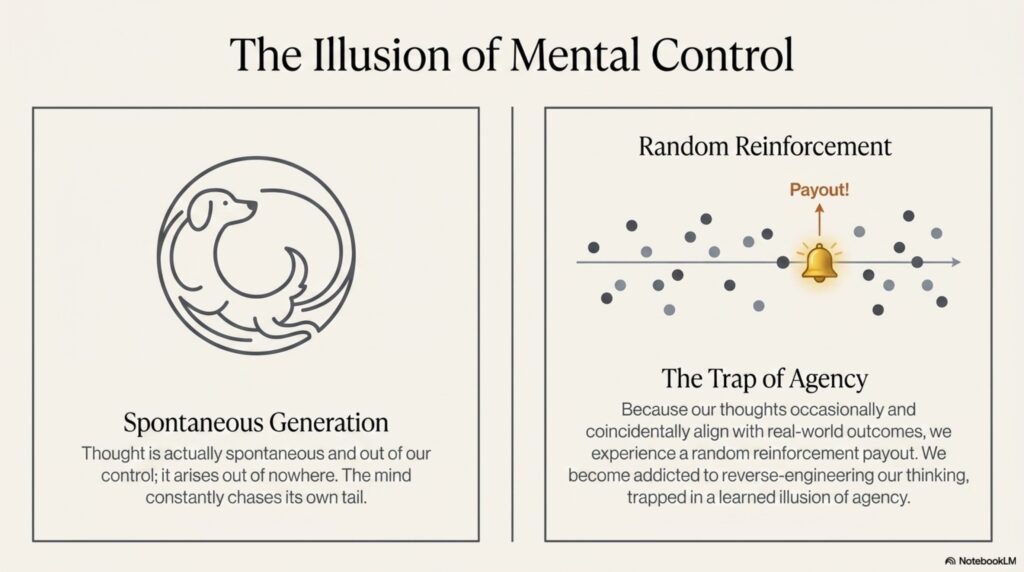
- Random reinforcement (like gambling) explains why we stay addicted to believing thinking solves problems.
The following ai content is based on Kat’s Monday recording from July 6, 2026, titled “identifying with thought” (https://katoudheusden.com/inquiries):
The Sky and the Clouds: – A Beginner’s Guide to Thoughts and Awareness
NotebookLM:
Welcome to a fundamental shift in how you relate to your inner world. Most of us spend our lives under the impression that we are the authors of our thoughts and that our mental peace depends on “fixing” our minds. This guide explores the liberating realization that you are not your thoughts, but the vast awareness—the “Knowing Presence”—in which those thoughts appear and disappear.
1. The Automatic Mind: Recognizing the “Software”
The first step in finding freedom is realizing that thinking is not something you “do”—it is a process that happens to you. To see this, we only need to look at our direct experience.
Ask yourself: Do you know what your next thought will be?
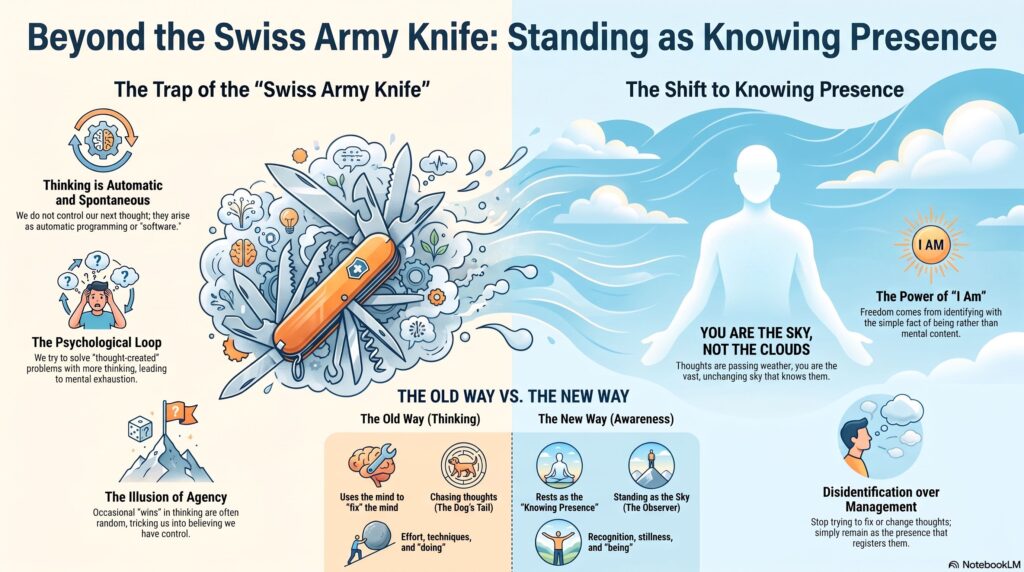
If you watch closely, you will see that thoughts simply arise out of nowhere. Even if you believe you have planned a thought, that “plan” was itself a thought that appeared spontaneously. We have been conditioned since childhood to believe we control our thinking, but in reality, the mind functions like a program running on its own.
Key Insight
Thinking is simply the “software” downloaded onto the human. It is an automatic, impersonal process. We don’t “do” our thinking any more than we “do” our heartbeat; it is a movement of the mind that functions without our conscious direction.
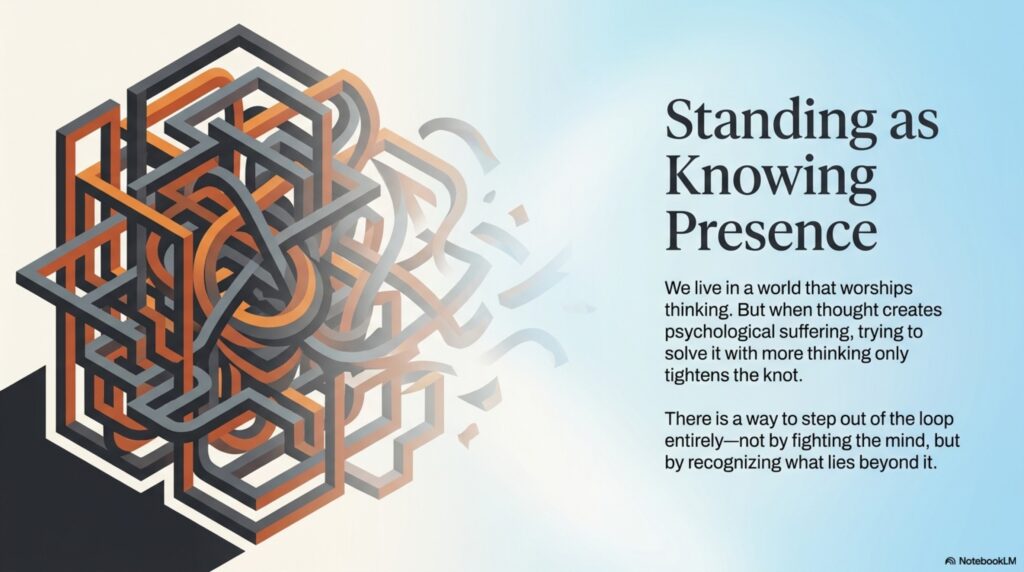
If our thoughts are an automatic software process, then our habitual way of “fixing” them is fundamentally flawed. We cannot debug the software by using the same broken code that created the problem in the first place.
2. The Trap of the “Swiss Army Knife”
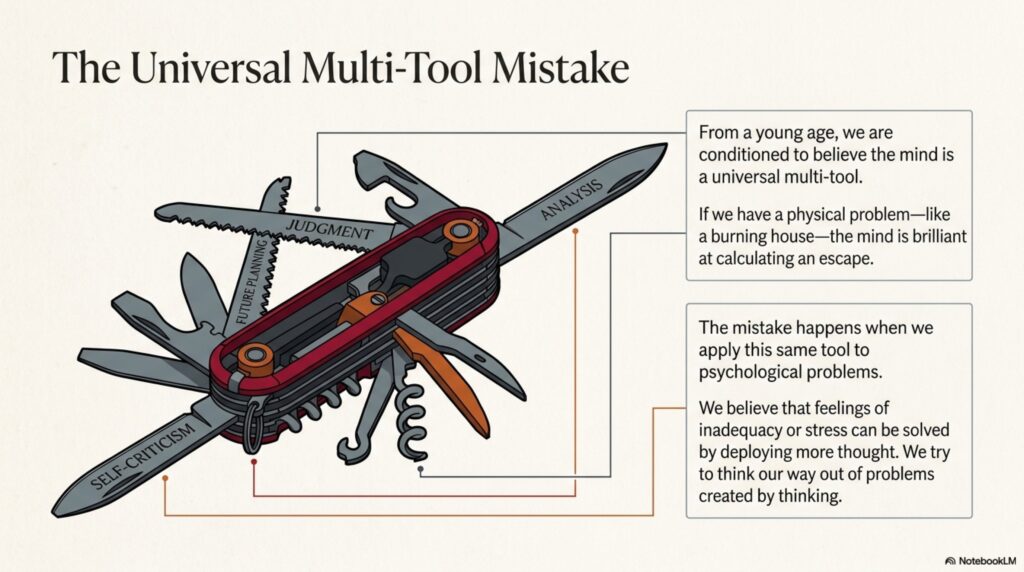
The mind is a “Swiss Army Knife”—a multi-purpose tool that is incredibly effective for solving physical problems. However, we stay stuck because we try to apply this same tool to psychological issues.
This trap is especially “sticky” because of a phenomenon called random reinforcement. Much like a slot machine, the mind occasionally produces a thought-based “solution” that seems to work by pure chance or luck. Because of our inherent bias, we reverse-engineer this “win,” convincing ourselves that our thinking caused the relief. This unpredictable “feeding tray” keeps us addicted to the cycle of more thinking, hoping that if we just find the right framework or philosophy, we will finally win for good.
| Problem Type | Example | The “Tool” Used | The Result |
| Physical Problems | A house burning down | Practical Thinking | Problem is addressed and resolved. |
| Psychological Problems | “I’m not good enough” | Questioning beliefs, choosing positive thoughts | More thinking, judgment, and “rabbit holes.” |
When we try to solve a psychological problem with more thinking, we are just picking up the Swiss Army Knife again. To find real peace, we must recognize that the next “tool” we need isn’t a “doing” at all—it is a shift in identity.
3. The Sky and the Clouds Analogy
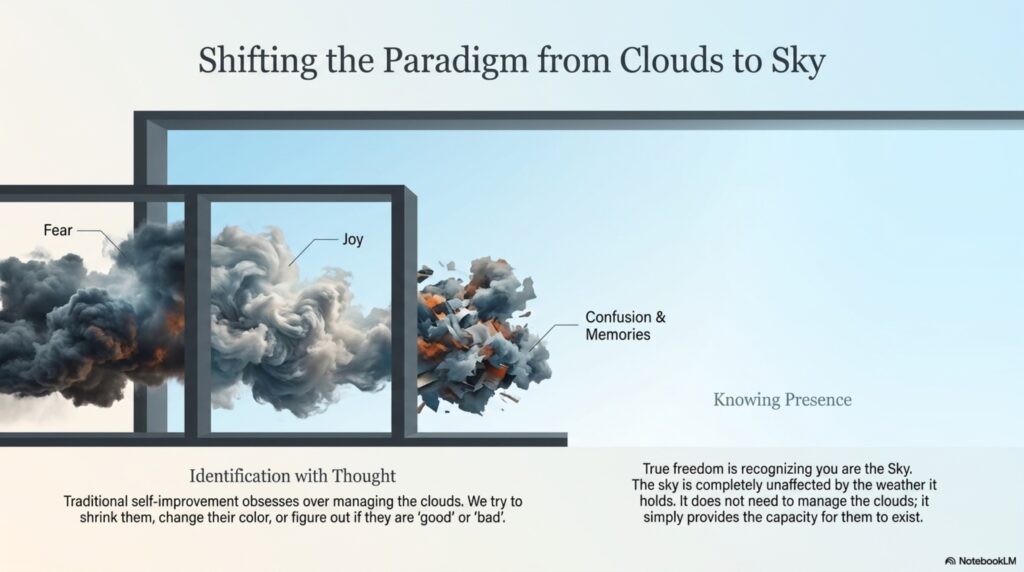
To understand your true nature, consider the relationship between the Sky and the Clouds. Most of us spend our lives obsessing over the clouds—trying to manage them, shrink them, or determine if they are “fear clouds” or “love clouds.”
- The Clouds (Thoughts & Sensations):
- Temporary and constantly changing.
- Spontaneous and impersonal; they arise, stay a while, and go.
- Varied in “weather”—ranging from beautiful insights to stormy emotions.
- The Sky (Awareness / Knowing Presence):
- Unchanging, vast, and always present.
- The “background” or “ground” that allows the clouds to exist.
- Untouched by the weather; the sky is never wet from rain or burned by lightning.
The mistake is identifying with the clouds. When you recognize that you are the Sky, you no longer need the clouds to go away to be at peace. You are the vast, knowing presence that remains unchanged even as the most violent storm passes through. This leads us from the visual analogy to the direct internal experience of “Knowing Presence.”
4. Shifting from “Doing” to “Being” (The Non-Practice)
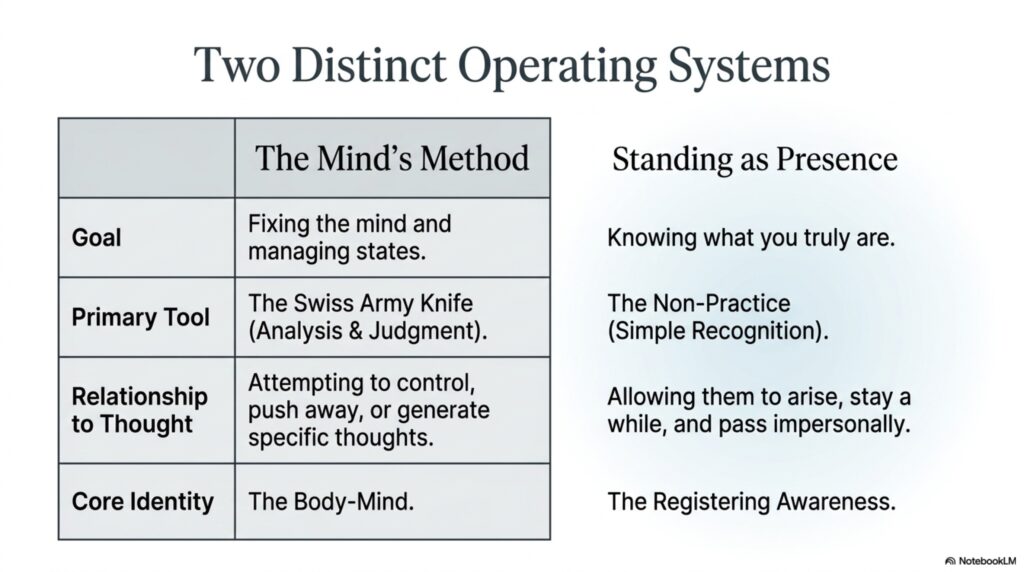
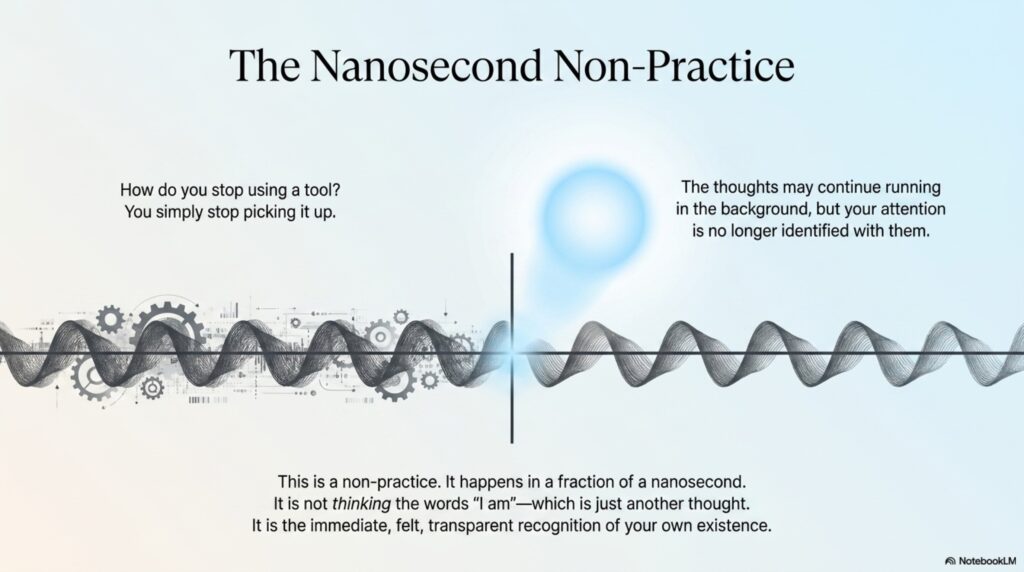
Traditional self-improvement often feels like more “doing” with the Swiss Army Knife. Non-duality offers a “non-practice” called Recognition.
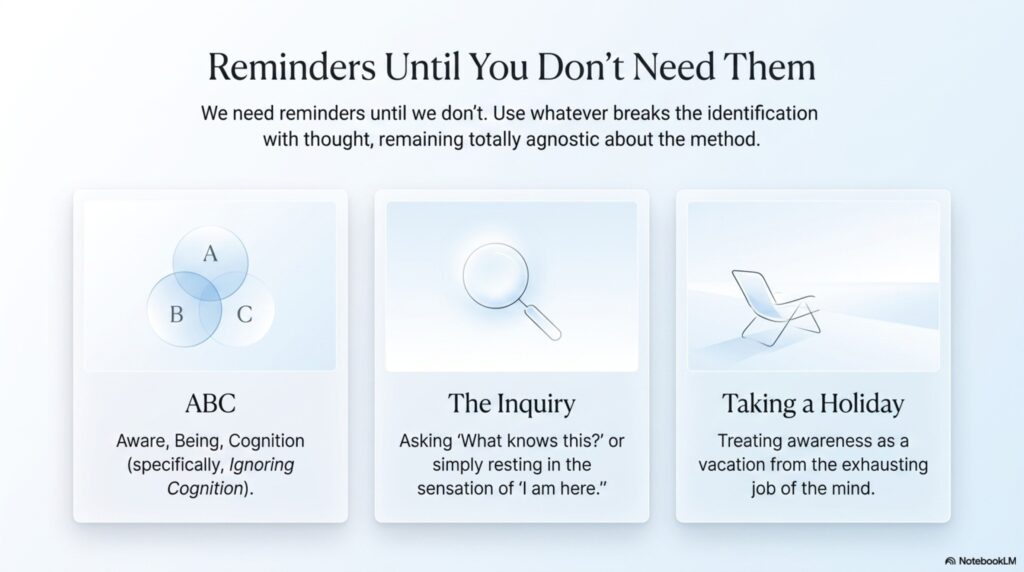
It is vital to distinguish between the thought of being and the actual recognition of being. The words “I am” are just more clouds. The recognition we are looking for happens in the fraction of a second before the words arise—it is a transparent, content-less registering of your own existence. We call this the ABC mnemonic: Aware of Being while ignoring Cognition.
Follow these Three Steps of Recognition to return to your True North:
- Notice the movement: Observe a thought or emotion arising as a “mental sensation.”
- Ask “What knows this?”: Shift attention away from the content of the thought and toward the fact that it is being registered.
- Rest as the registering itself: Simply remain as the “knowing” that is present right now. You know you are here. You know you are not dead. Stand as that knowing.
This recognition is not a meditative state you must achieve; it is available even during intense emotions, difficult conversations, or life-altering events.
5. Dealing with “Stormy Weather”: Strong Emotions and Doubts
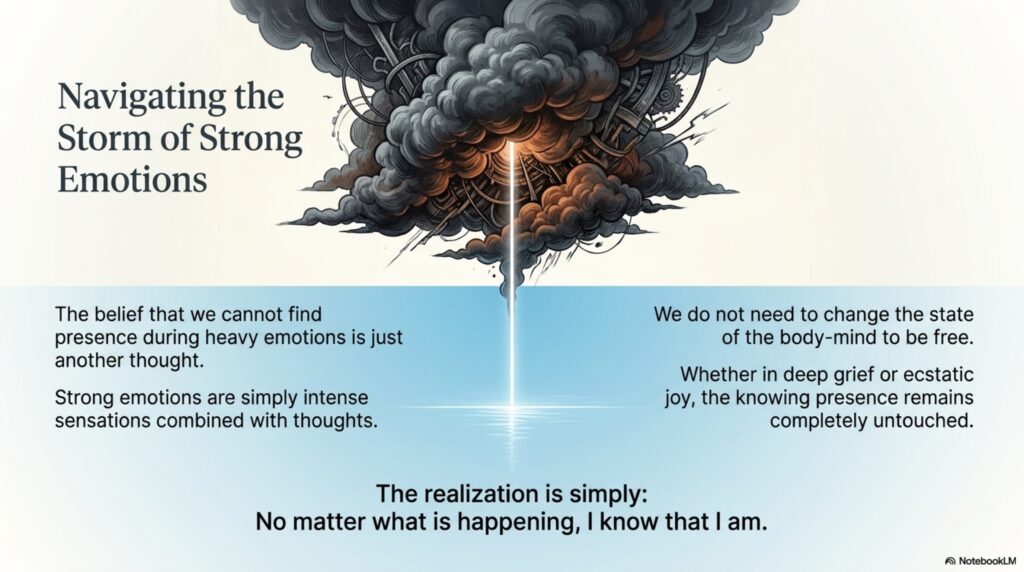
A common concern is: “What if my emotions are too strong to recognize the Sky?” We often believe that a heavy storm means the Sky has disappeared. But the very fact that you know you feel heavy or anxious proves that the Sky (Awareness) is there, registering the storm.
Freedom is not about “state management.” There is no “one” inside who needs to manage states. Trying to use this analogy to feel better is just more “cloud management.” Instead, we stand as the Sky while the storm happens.
“We can do nothing about thoughts and emotions; they are not our job.”
Whether you are ecstatic or in the middle of a “stormy” year, the “I am” presence is the home you never actually left. You are not the body-mind experiencing the storm; you are the knowing in which all states come and go.
6. Summary: Your True Identity
The shift from identifying with thought to standing as awareness is the root of awakening. The solution is not to find the “correct” thought, but to recognize yourself as the “knowing” that witnesses every thought.
Learner’s Cheat Sheet
- Thoughts are Software: You don’t control them. Stop trying to “think” your way out of the addiction to thinking; it’s a slot machine you can’t win.
- You are the Sky: Your thoughts and emotions are just weather. They cannot damage or define the vast awareness that you are.
- The “I Am” Recognition: Whenever you feel caught in the clouds, don’t analyze the clouds. Simply ask, “What knows this?” and rest in the silent registration of the moment.
The simple recognition of your own existence—the “I am” that precedes all words—is the antidote to the mind’s complexity. Standing as this Knowing Presence, you finally return to the peace that is your natural state.
Leave a Reply